Defying the Odds: The Courage of Razia Sultan and Joan of Arc
Throughout history, the tales of women who rose above societal constraints to lead, fight, and influence are both awe-inspiring and, unfortunately, often underrepresented. Razia Sultan, the first and only woman to ascend the throne of Delhi Sultanate in India, and Joan of Arc, the French peasant girl turned military leader and saint, are two such figures. Despite their distinct cultural contexts, they share profound similarities in their stories of defiance, leadership, and tragic demise. Their contributions to society, though monumental, often seem relegated to the margins of historical discourse.
A remarkable period in the history of the Delhi Sultanate is marked by the reign of Razia Sultan. It was distinguished by her fearless rejection of social norms and her remarkable leadership in a patriarchal society. Her accession to the throne in 1236 made her the first and only female ruler, of the Delhi Sultanate which was a groundbreaking achievement in itself. Razia's cutting-edge reforms defined her rule; she pushed for meritocracy above inherited privilege, promoted administrative efficiency, and sought to curb the dominance of the Turkish nobility, asserting the authority of the central government. She promoted religious tolerance while encouraging an atmosphere of intellectual and cultural development, making her rule renowned for its openness. Beyond her ability to govern, Razia showed great military skills, using strategic judgment to protect her realm from both external threats and internal dissension. Her decision to dress and behave like a queen instead of playing the stereotypically female roles was a challenge to social standards as well as a declaration of her power.
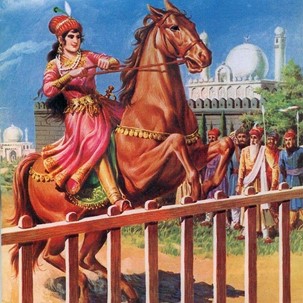
Source: Pinterest
During one of France's darkest periods, Joan of Arc, a peasant girl who became a warrior, carved a path through history with her unwavering faith and exceptional leadership. During the Hundred Years' War, she rose from obscurity and claimed to have had divine visions calling her to rescue France from English rule. Joan accomplished an unprecedented feat for a woman in medieval Europe when she persuaded a reluctant Dauphin Charles VII to give her command of an army at the age of 17. The French won several battles under her command, most notably the Siege of Orléans, where her valour and strategic acumen changed the course of the conflict. Joan's presence united a nation divided by conflict and hopelessness, inspiring both troops and citizens. In addition to her military accomplishments, she became a living symbol of hope, solidarity, and divine providence. Joan was captured and put to death at the age of 19, and her martyrdom made her a living example of courage and patriotism.
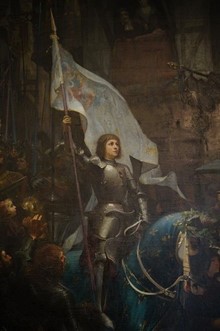
Source: Pinterest
Both women transcended the roles prescribed to them by their eras, becoming symbols of resistance and inspiration—Razia as a beacon of women’s potential in governance and Joan as an emblem of divine intervention and national unity. However, their brilliant work was greeted with opposition; Joan was captured and put to death, while Razia was betrayed and killed, both of their early deaths serving as tragic examples of society's discomfort with strong women. Razia's life has been immortalized in literature and history, while Joan has been declared a saint, but both are still mainly ignored in mainstream narratives. Famous contemporary works on Razia Sultan in the modern times include: “The Teenage Diary of Razia Sultan” by Anitha Murthy and “Becoming Razia Sultana” by Rishav Banerjee. Some contemporary work on Joan of Arc include Joan of Arc: Her Story by Régine Pernoud The Language of Fire: Joan of Arc Reimagined by Stephanie Hemphill, Joan of Arc: The Image of Female Heroism by Marina Warner
However, patriarchal history, cultural opposition to their defiance of convention, and a regrettable obsession with their premature deaths rather than their lasting accomplishments are the causes of this neglect. Their tales force us to reexamine the past through a more inclusive prism, acknowledging their contributions as crucial periods in humanity's continuous fight for justice and equity rather than as aberrations.
Joan of Arc and Razia Sultan are prime examples of the age-old conflict between personal initiative and social norms. Their lives force us to think critically about gender, justice, and power structures. They serve as a reminder that brilliance frequently comes at a high personal cost and that those who challenge the status quo make sacrifices that lead to societal advancement. The absence of them from historical accounts reflects our societal unease with those who defy expectations. Nevertheless, these narratives survive as lingering traces in cultural memory, ready to motivate future generations to challenge and oppose unfair structures.
- Basham, A. L. The Wonder That Was India. New York: Grove Press, 1954.
- Pernoud, Régine. Joan of Arc: Her Story. New York: St. Martin's Griffin, 1999.
- Habib, Irfan. Medieval India: The Study of a Civilization. Delhi: National Book Trust, 2008.
- Taylor, Larissa. The Virgin Warrior: The Life and Death of Joan of Arc. Yale University Press, 2009.